
Thinking in wilderness time
By Mason Parker, Wilderness Watch

“What goes too long unchanged destroys itself. The forest is forever because it dies and dies and so lives.” – Ursula K. Le Guin
I rode south from the Bay with René Voss, over Dumbarton Bridge and through California’s Central Valley. Outside the passenger window, the valley unfurled in rows of oranges and almonds, each well-watered and perfectly manicured. John Muir once called this place “The floweriest piece of the world.” Now, the orchards look unnaturally green beside acres of dying grass struggling to grow in wetlands siphoned dry a century ago. There are signs propped in front of pistachio fields that read, “Governor Newsom stop dumping 78% of our clean water into the ocean.” But haven’t rivers and rainfall always flowed into oceans?
René is an environmental attorney that represents the John Muir Project (JMP) and a Wilderness Watch board member who possesses an encyclopedic knowledge of nature and conservation, from bird calls to case law. We joined the rest of the crew at a house outside Sequoia & Kings Canyon National Parks (SEKI), an eclectic group of documentarians, poets, activists, scientists, and lawyers. As the sun set across the Sierras, we chatted over cold pizza and warm pilsner, preparing for a walk into the Wilderness.
Dr. Chad Hanson, a fire ecologist and the Director of JMP, spoke fervently on the anatomy of the black-backed woodpecker—a critter he calls an evolutionary marvel. It is a three-toed woodpecker, and a keystone species. Two toes face forward and one toe faces back, allowing the bird to pivot further and hammer harder into fire-seared snags. This is anatomically unique, as woodpeckers are commonly of the four-toed variety. The black-backed woodpecker’s bill is thick and chisel-like, a perfect tool for its yearly construction of nesting cavities, which are left for secondary cavity nesters—owls and chickadees who are unable to carve their own homes. It’s a naturally gifted and remarkably generous bird, this woodpecker, and it depends on recent high-intensity fire for its survival, thriving in the first decade or so after a burn when food and nesting opportunities peak. As Dr. Hanson spoke, twilight set in, and a California black-tailed deer wandered through the yard chewing grass. Bats fluttered between oaks whose limbs were woven into the violet-gray sky in crooked tangles of black.
The next morning, I found myself standing in the shadow of a giant sequoia for the first time. I had a vision of this land long ago when it was primeval and teeming with megafauna. A time before humans ascended as apex killers, using our tools and our weapons to bring about an era of great loss that historians call the Quaternary megafauna extinction.
After 35 million years on Earth, the giant ground sloth was exterminated.
After 25 million years on Earth, the mastodon was exterminated.
After just 3.7 million years on Earth, the woolly rhinoceros was exterminated.
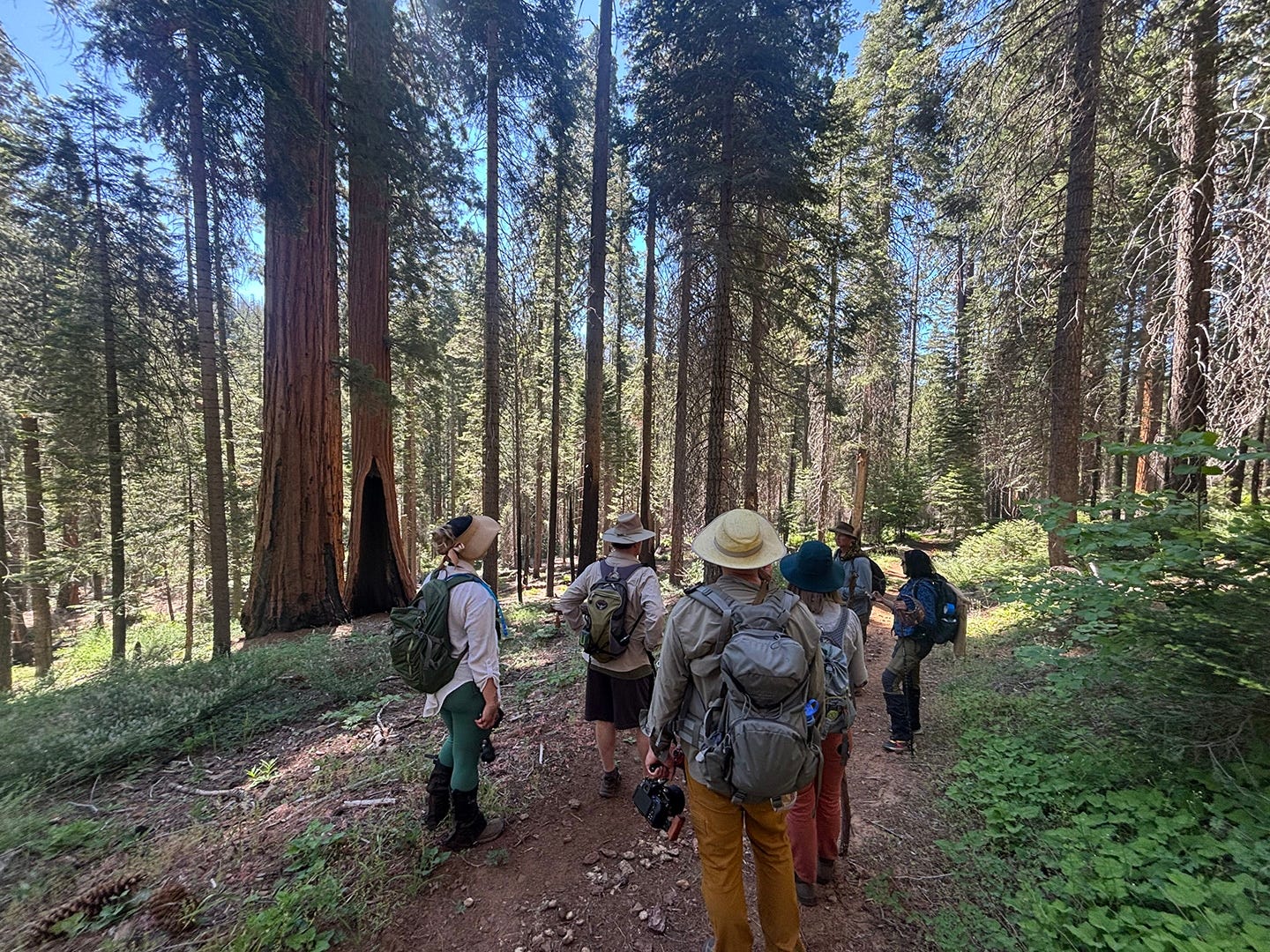
But these giant trees are still here, despite everything—a monument to the ancient species that roamed this land before we came and crashed the party. Standing in front of the giant sequoias feels like stepping into a time machine, like I should be watching my back for sabertooth tigers and keeping my ear to the ground for woolly mammoth herds.
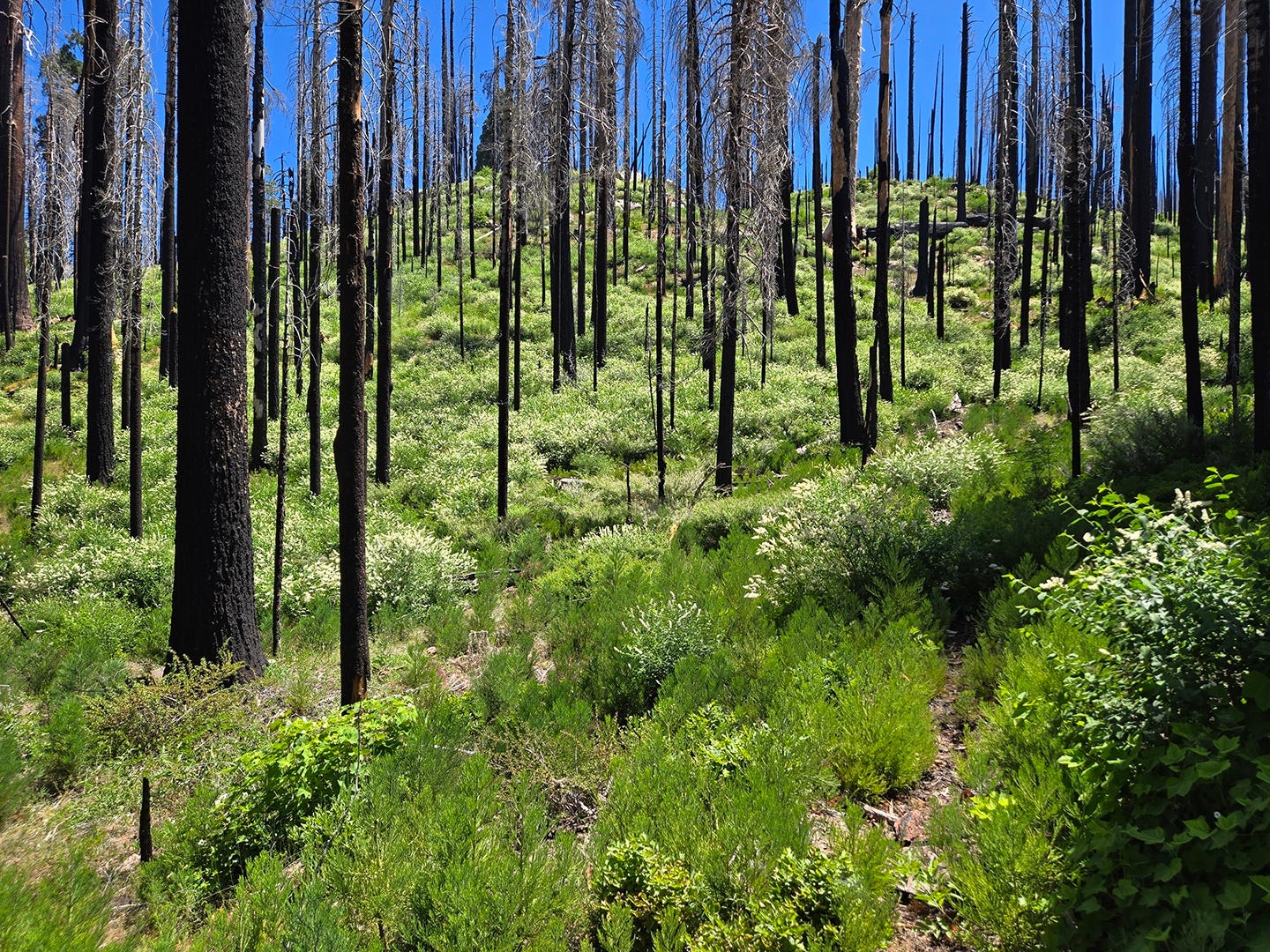
Redwood Mountain Grove is located in the Sequoia-Kings Canyon Wilderness, which comprises around 800,000 acres of SEKI. To the untrained eye, Redwood Mountain Grove might look decimated by the wildfire that burned through four years ago in the 2021 KNP Complex Fire. At least that is what the Park Service would have you believe. Only weeks after the KNP Fire, the agency claimed that the severity was so high that nothing could grow back. They peddled a narrative that the sequoia cones were incinerated in a “catastrophic” inferno, and nearly every giant sequoia in the grove was dead. The agency was wrong on both accounts. Round sequoia cones covered the ground in such a concentration that they had the effect of a floor covered in marbles. We had to step carefully, or we risked a painful slog out of the wilderness, nursing a bruised tailbone or a minor concussion. Above us, green tufts of regrowth, called epicormic branching, stuck from the crown of charred sequoias.
The government has methods for manipulating the discourse around conservation. One of these methods is the development of a new vocabulary they use to discuss these issues. According to the agencies, when a predator is shot down by a hunter, it’s not killed, it’s “harvested.” Similarly, when they talk about plants in a forest, they are no longer trees and grass and shrubs, instead they become “fuels,” and cutting down forests becomes an act of “fuels reduction.” This type of doublespeak is employed intentionally to manufacture public consent. Animals become plants and plants become objects.
Dr. Hanson has written and edited two books on fire ecology, and published numerous papers on the post-fire ecosystems of snag forests that thrive in the aftermath of high-intensity fire. I’ve heard him described as a “lightning rod,” which makes sense. During several of his lectures in the field, he stated bluntly, “Your government is lying to you.” Based on what we saw in the Sequoia-Kings Canyon Wilderness, Dr. Hanson is right.
The Park Service planted 100-200 seedlings per acre, a mix of sequoia and conifer. In less than 10 months, the agency had observed a 70 percent mortality rate among their planted seedlings. However, in the areas that were allowed to regrow naturally, Dr. Hanson estimates that there are an average of 25,000 seedlings per acre. In contrast, the Park Service estimates only 4,000 seedlings naturally regrowing per acre. Regardless, it begs the question: what’s the point in artificially seeding this post-fire landscape when the natural regeneration far exceeds the outcome of planting?
Among the concerns about the impact that planting could have on the natural regeneration of sequoias is the addition of artificial competition, the trampling caused by park employees and pack stock, and the introduction of dozens of root pathogens. Root pathogens can kill both seedlings and mature trees. The agency claimed that they keep a list of certified nurseries where seedlings are tested and treated for root pathogens. This may be true, but there’s a problem: the seedlings they planted were not sourced from these certified nurseries.
Quietly, I thought of Suzanne Simard’s research on communication and memory among forest ecosystems in her book Finding the Mother Tree. I wonder if some of this failure has to do with the introduction of seedlings that diverge genetically from those that have known this grove for centuries, communicating in an underground network of roots and fungi to exchange carbon, nutrients, and defense signals. Even now, after Dr. Simard’s theories on plant intelligence have been reinforced by peer-reviewed research, it seems too woo-woo, the implications too metaphysical, to bring into the conversation. So, I kept it to myself. But Dr. Hanson highlighted this same phenomenon in scientific terms, avoiding the language of plant intelligence that I am perhaps prone to employing a little too casually (or, maybe I’m hanging out at the wrong kind of parties). Agencies speak in terms of data and research, not philosophy and spirituality (and certainly not in terms of intelligence, human or not). Instead, Dr. Hanson talks about grove-specific genetic variations that lead to evolutionary adaptations within the progeny of parent trees.
“They are going to keep replanting until they teach this forest about real regeneration,” Dr. Hanson quipped.
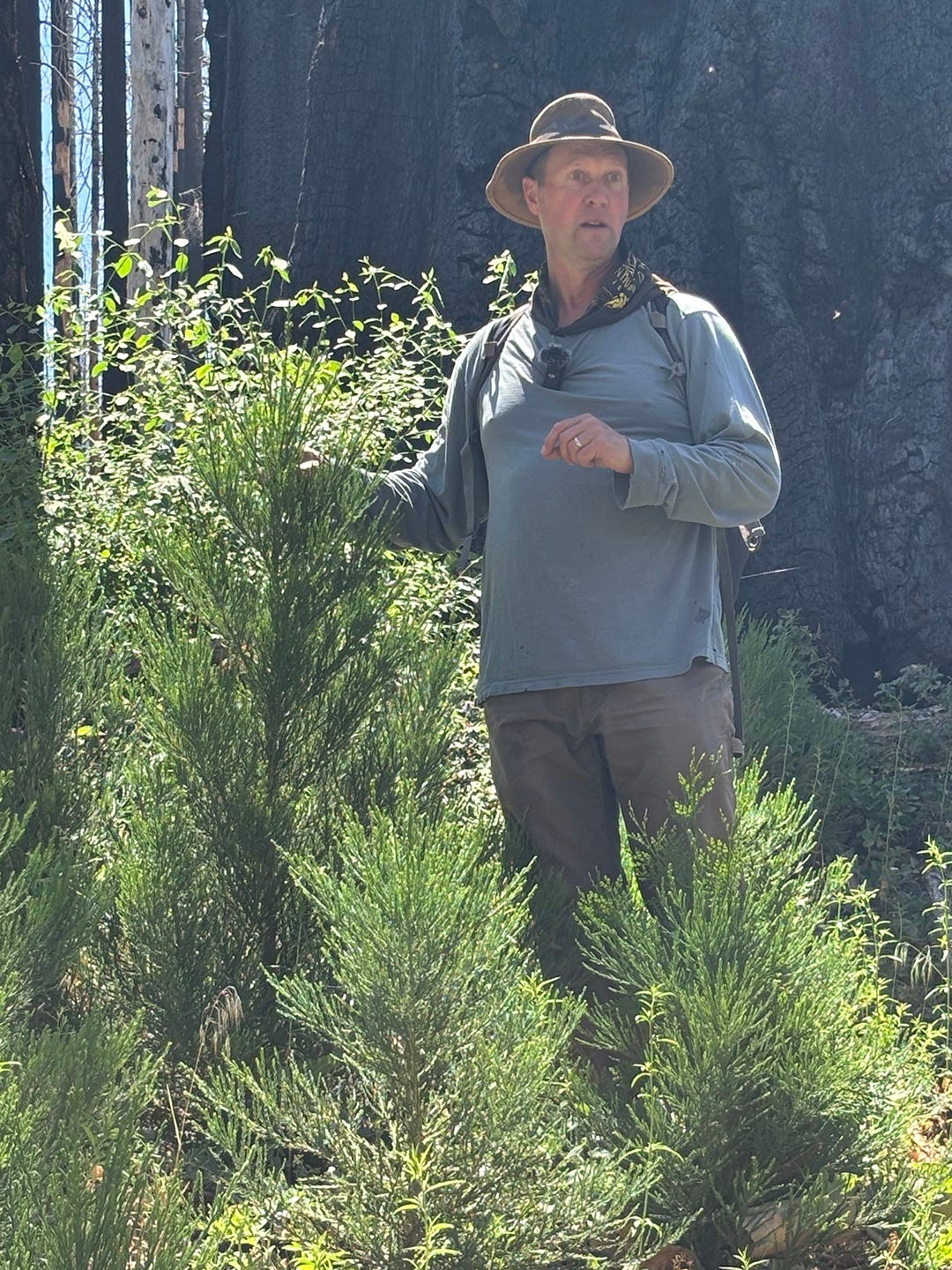
Making our way through the snag forest left behind by the high-intensity fire, we waded through sequoia seedlings ranging in height from five inches to over five feet. It was clear that the rejuvenation had been ongoing since the ash of the KNP Complex settled. On the contrary, we came across planted seedlings marked with identifying silver tags that were dead or dying. They were the golden-brown color of dead trees, only 5-10 inches tall. They never stood a chance.
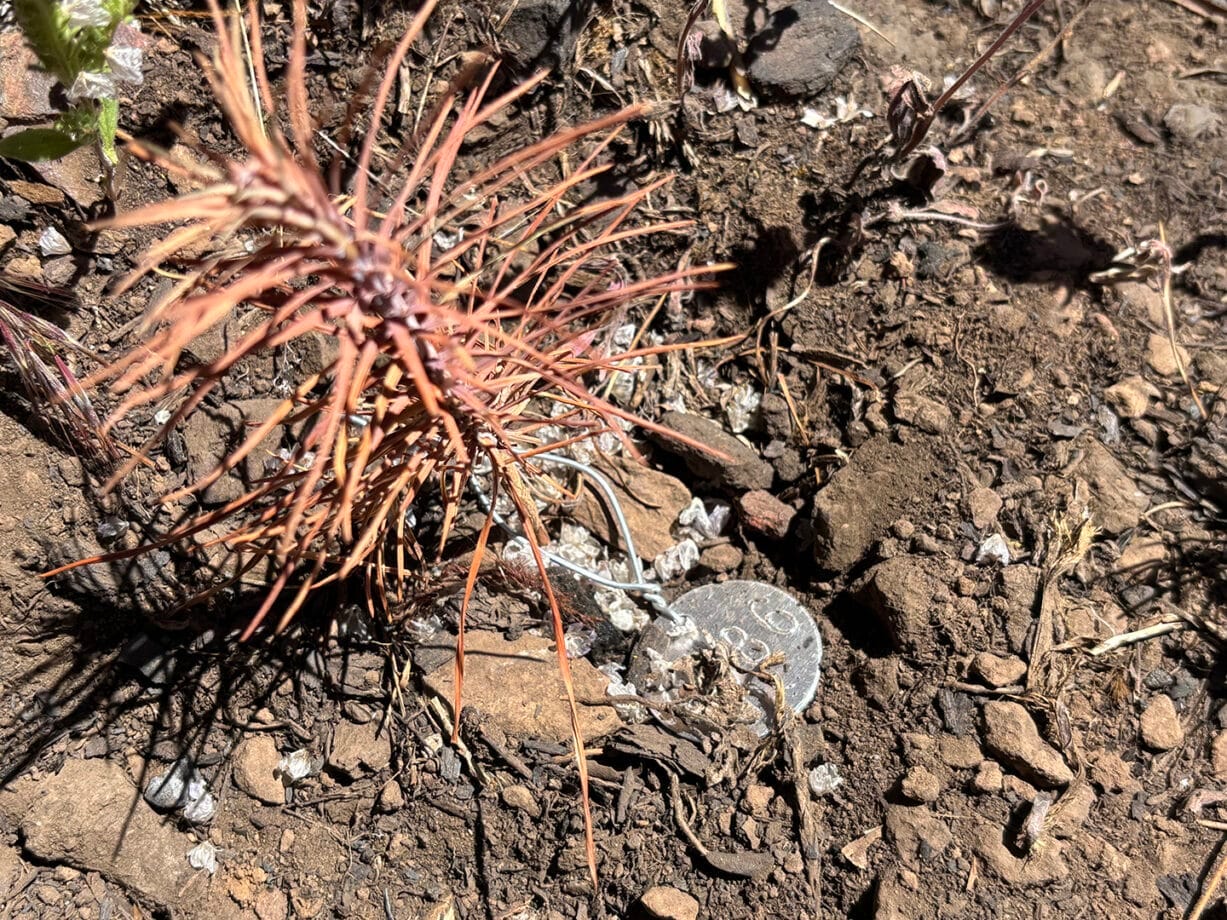
The Sequoia-Kings Canyon Wilderness was peppered with pink plastic flags that read cutesy things like, “Babies!” scribbled in sharpie. The flags were blown over, littering the forest floor. There were clear signs of chainsaw use, cow patties covered the ground, and we came across several human-built research devices whose purpose was unclear. It makes you wonder if there is any way in which the agency is managing this place like Wilderness.
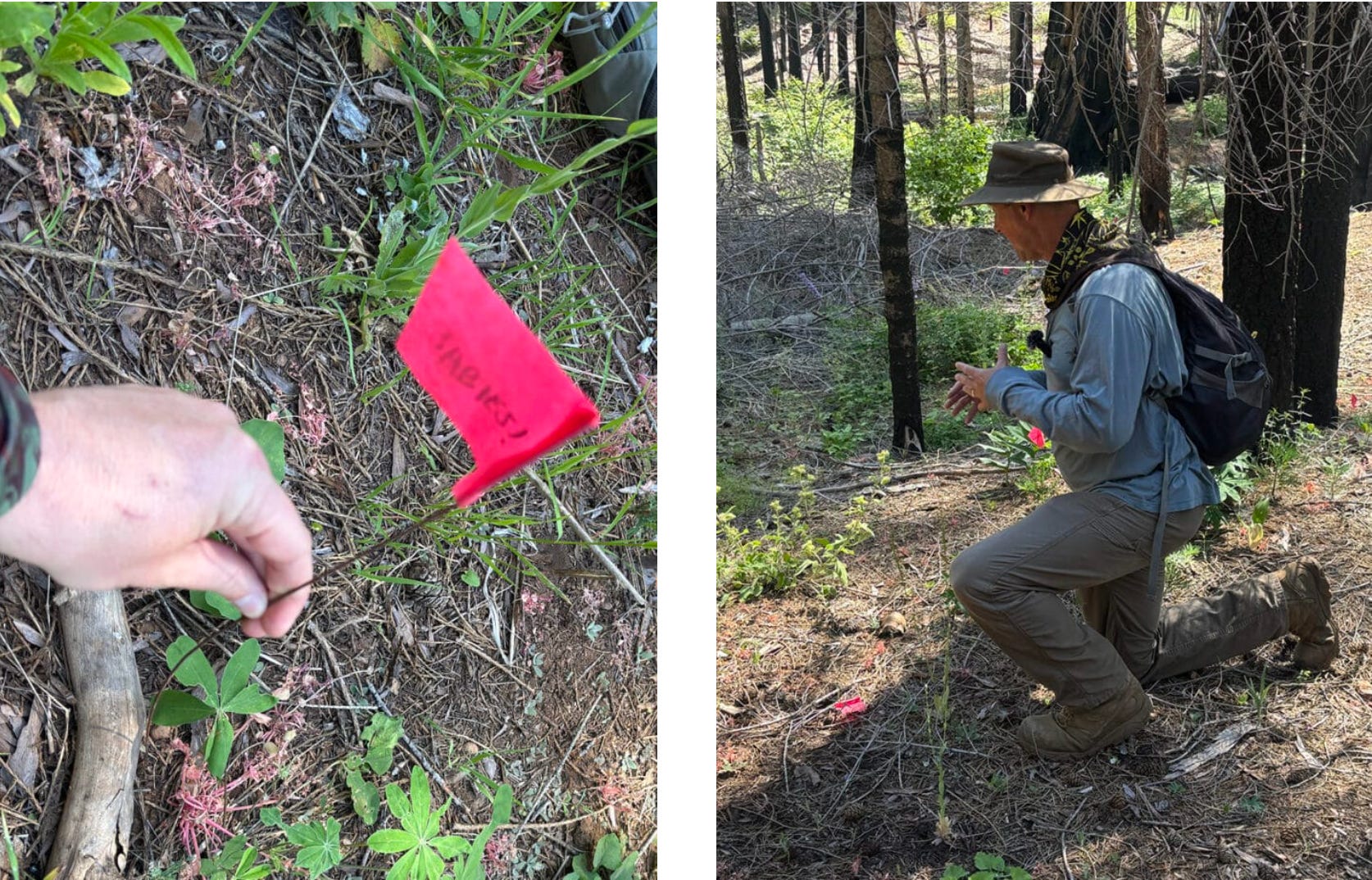
Again, the Park Service has made a number of dubious claims that are easily disputed by anyone with a set of eyes and a basic understanding of what they are looking at. The problem is, the agency has not allowed the public into the burned groves to see the rejuvenation for themselves. The area has been closed since the KNP Fire and trespassing holds a penalty of up to six months in jail. We were only allowed to walk through the grove because Dr. Hanson attained a permit for conducting preliminary research.
The management issues in the Redwood Mountain Grove speak to a larger cultural problem: the demonization of wildfire. Increasingly, we seek to distinguish good fire from bad fire, when in reality all fire, whether low-, mid- or high-intensity, plays a vital role for thriving ecosystems. Wildfire is not spreading into our cities and towns, our towns and cities have spread into wildfire terrain. Even so, the solution does not appear to be the cutting and burning of our forests. Mounting evidence shows that these practices may actually increase the intensity of wildfires, as was the case with the Camp Fire which burned through several thousand acres that had been logged under the guise of “fuel reduction.” These areas burned rapidly in the first few hours of the wildfire. Mounting research shows that fire intensity is not based on “fuels,” it is based on drought conditions and wind. Unfortunately, dry and windy conditions are becoming more prevalent due to climate change. Through mechanical thinning and pile burning or manager-ignited fires, the agencies create forests with dry undergrowth and no windbreaks—the exact conditions that feed wildfire intensity. Further, we are destroying the planet’s organic system for capturing carbon, which contributes to the changing climate, causing more drought and increasing winds. It is a dangerous feedback loop that must be broken before it spins out of control.
That’s not to say that there is nothing that can be done. As a matter of fact, there are solutions available that have been tested and the findings are a point of scientific consensus among both the Forest Service and independent fire researchers such as Dr. Hanson. The solution is home hardening. In a research paper titled Preventing Disaster, the Forest Service itself found that, “Because home ignitability is limited to a home and its immediate surroundings, fire managers can separate the… structure fire loss problem from other landscape-scale fire management issues. The home and its surrounding 40 meters determine home ignitability, home ignitions depend on home ignitability, and fire losses depend on home ignitions. Thus, the… fire loss problem can be defined as a home ignitability issue largely independent of wildland fuel management issues.” The best way to prevent the destruction of homes by wildfire is to take steps to reduce the ignitability of the structure and its immediate surroundings. Broadly speaking, home hardening consists of creating a defensible space around your house, using fire-resistant materials, and sealing vulnerable areas such as vents, garages, and eaves. In short, defense against wildfire starts at home, not in the wilderness.
Walking through the fire patches in Redwood Mountain Grove, I am struck by a simple and fundamental truth in all of this: Wilderness works. We see this truth over and over again, but only on those rare occasions when humanity overcomes its hubris and practices a bit of restraint. The agencies appear hellbent on stripping wild nature of its agency, likely based on the presumption that human intelligence is situated above non-human intelligence in an imagined hierarchy of intellect. When you look at the awful mess the agencies have made in less than a hundred years of “management,” you have to question the truth of this assumption. Particularly when compared to the intricate, balanced design of millions of years of evolution.
It isn’t only the sequoias that thrive in this post-fire ecosystem. Four years after the burn, the presence of life inside the high-intensity fire patch was almost overwhelming to the senses. Wildflowers and grasses grew in a kaleidoscopic blanket of greens, purples, and blues covering the forest floor. The sound of birdsong and the rhythmic thumping of woodpeckers filled the air, and all of it was illuminated by the sun and the bright blue sky.
When I can’t make sense of things, which is often the case these days, I turn to the wisdom of the ancient Chinese wilderness writers. Not only did these misanthropes manage to shirk the responsibilities of a civilized life, instead spending their days guzzling wine among the maples and thrushes, but they also lived in a time that seemed simpler than ours. A time when fundamental truths about nature and existence seemed more accessible, less hidden under complex layers of technology, social engineering, and the general bullshit of modernity. In his poem “Form Shadow Spirit”, T’ao Ch’ien writes:
Heaven and earth last. They’ll never end.
Mountains and rivers know no seasons,
And there’s a timeless law plants and trees
follow: frost then dew, vigor then ruin.
They call us earth’s most divine and wise
things, but we alone are never as we are
again. One moment we appear in this world,
and the next, we vanish, never to return.
Now, I’m no scholar of ancient Chinese poetry, but it seems to me that T’ao Ch’ien is speaking to the linearity of human life and the enduring cycle of forests. He prods at our perception of time, an illusion based on our relationship to our own life and death. We are born, we age, and we die. In between time seems to move forward at a breakneck speed, refusing to slow down no matter how hard we try. When Dr. Hanson sees the regrowth of giant sequoia saplings in the snag forests, he urges us not to mourn the loss of the giant sequoias, but instead celebrate the vigor of regrowth blossoming from what we perceive as ruin. Ecological time functions on a scale much vaster than human time. After all, 80 years, or the average lifespan of a human being, is only a fleeting moment in the existence of a forest. This is something that agencies cannot, or will not, incorporate into their management approach. Here and now, we are lucky enough to witness a rare and beautiful occurrence inside the groves of the Sequoia-Kings Canyon Wilderness—a rebirth that only happens every 600 years. Yet, we are maligning what we should be celebrating.
After our excursions, everyone went their own way. René and I peeled off to climb Mitchell Peak, a mountain that rises from the center of SEKI, so that everything you see in all directions is Wilderness. The valleys below were filled with green spires rolling in waves across the landscape. Old and ancient trees unburned, stood waiting for the flames to come and propel them forward along the eternal cycle of rebirth that forests have known for millennia. Looking out over this expanse of wilderness, it seemed endless, and I had questions for no one in particular, just asking them of myself in the solitude of the mountaintop.
Do we not want rivers to flow into oceans? Do we not want trees to grow wildly in forests? Do we not want wildfires to burn across these fire-dependent landscapes in a sweeping canvas of renewal?
If not, then it seems we are at odds with the balance of life itself. I fear for a world in which everything is dominated by human will and managed according to our desires. I look at what we’ve created and destroyed with our intelligence, our tools, our “abundant” resources, and I can hardly stomach the idea of a planet robbed of its wildness, in which everything is manufactured entirely in our vision. Looking out from the top of Mitchell Peak, you do not see something that needs to be fixed. Rather, you bear witness to the staggering beauty of lands largely unscathed by human interference and wonder how we think we can improve upon this.
Mason Parker is Wilderness Watch’s Wilderness Defense Director.
Thank you.
Just thank you.
🌱🌿💚
Very disappointed in a couple of things: We can quibble about Giant Sequoia seedlings and distribution but, really, so what? While great there's regeneration it's the completely unprecedented loss of the ancient (> 1,000 to 3,000 year old) trees -- in only the last 5 years (!!) -- that is the true tragedy. It is these awe inspiring "Monarch" Giant Sequoias that are the very reason for the panic among researchers and the public on how to accelerate protection efforts.
Fires capable of destroying the crown (and, so, cones & seeds) of a Giant Sequoia -- especially the ancient ones -- just didn't happen. Solid research shows that for at least the last 1,000 years, fires through Giant Sequoias were mostly ground fires with occasional flare up but, in any event, did not destroy the larger taller trees.
The author and Dr. Hanson seem happy that the grove is getting regeneration (and accuse the NPS of "hiding that fact" -- say what??) but there's no mention at all of the overall threat of recent major crown fires destroying 15% + of ancient Giant Sequoias. THAT'S the problem. The Groves that have had high mortality have all had fire suppression in and nearby them for decades. The Groves that have had 100% survival have been ones that have had decades of prescribed fire (Mariposa Grove in Yosemite, Grant Grove in Kings Canyon, and the groves around Lodgepole in Sequoia Park.
And what's with this constant "NPS is hiding facts from the public"? Where does that even come from?? Yes, the Redwood Grove is closed to the public but that's because there's thousands of fire-killed trees and branches that can fall on people. That's standard practice in all recent burns anywhere, not just Redwood Mountain.
And this is the other tragedy: The NPS has problems -- I worked for them for almost 50 years -- but none of those problems are in their research division. Some really dedicated scientists trying to figure out how all the moving parts of an ecosystem -- streams, meadows, critters, terrain -- work together. All of that research and actual implementation in the field shows that restoring fire into conifer and Giant Sequoia ecosystems reduces the fuel loads that cause these unprecedented crown fires. Articles like this just help to feed a paranoid 'anti-gubmint' narrative rather than a serious look at actual facts.
For an overview of the Kings Canyon Complex fire as it affected Redwood Mountain -- and specifically how Dr. Hanson has misinterpreted and misrepresented many of the conditions there, read:
Effects of recent wildfires on giant sequoia groves were anomalous at millennial timescales: a response to Hanson et al.
Nathan L. Stephenson, David N. Soderberg, Joshua A. Flickinger, Anthony C. Caprio & Adrian J. Das
Fire Ecology volume 20, Article number: 89 (2024)
https://fireecology.springeropen.com/articles/10.1186/s42408-024-00316-5